How should one chase a thousand, and two put ten thousand to flight, except their Rock had sold them, and the LORD had shut them up? — Deuteronomy 32:30
(4)
Two things unite men even in the face of stark life hardships: love or hatred of living. As if in a simulation made up of mirrors, each magnifies the intensity of life in its varieties. But when these two conjoin, man becomes a vessel through which the sweet uses of adversity are ritualised—such as the fabled Christmas Truce of 1914, when soldiers from England and Germany—two hitherto enemies fighting to the death on the First World War front—dropped their weapons and played football on No Man’s Land.
This incomprehensible miracle becomes a manicula that beckons to a Yorùbá aphorism which, upon translation, states: “reproach finds company.” Therefore, when two friends who are physically disconnected by location find unison in suffering and longing for an ideal life, a deus ex machina is employed to reconnect emotions, jolt the mental bolts, and set their wills in motion, ultimately highlighting an extrinsic instrumentalisation of the digital game.
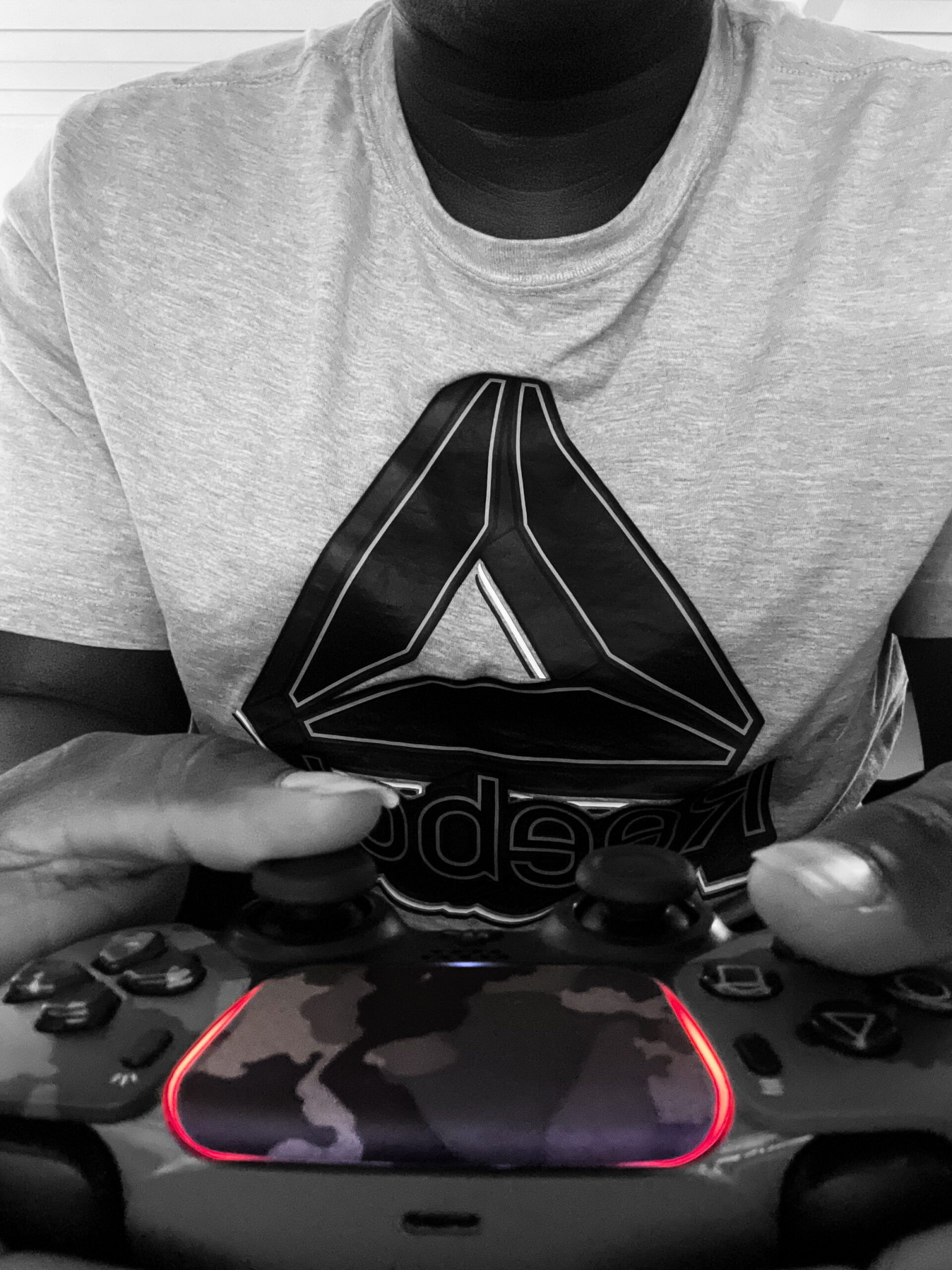
For these two friends—Olu and Oke*—you would permit me to begin in the second person before drifting into the first. This theatrical machine god, that is, the deus ex machina, reincarnates itself into a puppetry console yielding to the will of the gamer’s fingers as they play multiplayer PES 2025 while complaining about life, recalling high school adventures, taking turns to rant while the other listens, and taunting one another’s sufferings. What is the use of a quiet game anyway?
Unverified X statistics have revealed that male friendship is often characterised by benign toxicity, which sometimes camouflages itself as a form of sobriquet for an unpleasant event or a suppressed embarrassment expressed through jest. For instance, when Oke coined the pseudonym “Gratefulness Traps” for an acquaintance’s failed attempt at writing a philosophical research paper that observes how humans may fall into a perpetual trap of gratefulness, which may inhibit them from wanting more in life. Or when Olu christened another acquaintance “Ego Breaker” as a reference to his intention to diminish the confidence of his lover back home in Nigeria until she saw him as her only hope.
Pockets of stories like these are anecdotal in understanding benign toxicity. Of course, the phrase itself—oxymoronic and, when used outside the shores of medical science—refers to a form of micro-hostility that is survived through suppressed embarrassment and jest. It aims to diminish—or, at worst, disregard—the travails of the victim for the pleasure of perpetual amusement.
An example of this happened to Ayo, a high-school mate nicknamed “Fan Bender” after a fan accident that left a deep cut on the side of his head while he was sneaking out of the asbestos-roofed hostel. Thus, my intention, as you move through each sentence captured in this essay, is not to trivialise what I intend to discuss by focusing on the etymologies of nicknames—not that such a topic is not worth writing about—but rather to provide a context of instrumentalism in mundane things by spotlighting how PES 2025 helped two friends manage depression as they navigated life, graduate school thousands of miles from home, and strange social climates.
At this point, you might agree with me that the culmination of all a man knows is not solely dependent on how wrinkled his palms are, but rather on the sum of those whose palms have greased his. In other words, the environment in which a man grows up can tell us much about his childhood interests. This is why, for boys like us who grew up watching adults flash belt buckles adorned with the crests of their favorite football clubs, hold up sagging boot-cut trousers, paint their kiosks in the colors and logos of their teams, and spend weekends peering through wooden shop windows to watch Arsenal vs. Liverpool, QPR vs. Stoke City, Manchester United vs. Chelsea, and other contests for supremacy, football became an extension of the life we now live. The players who gifted us their skills and aura became demigods.
So, when the heat of Summer 2025 arrived, old interests resurfaced in the form of a PlayStation 5, and PES 2025 became a catharsis directed toward happiness and a life worth living.

(3)
All this began in 2014 at Christ’s School, Ado Ekiti, for Olu, and perhaps much earlier for Oke. The Ekiti State Government had begun distributing laptops to SS2 students the previous year for educational purposes, with the understanding that they would be returned at the end of the academic session. Protected by parental controls against external software, the laptops were handed out with a promise toward one thing—learning.
However, despite the diligence of Mr Olatunde, all that stood between students and digital freedom was the F7 key. Voilà—the laptop was restored to factory settings, and, like eating the forbidden fruit, Eve—now incarnated as the students—installed GTA, Konami Winning Eleven, and PES 2012. For others, the laptop became a miniature cinema.
Boys soon organised themselves into clusters of gamers and movie watchers, and among the boys of Ogunlade Hostel, the mixture was highly localised. Before long, they upgraded their Windows 7 Starter editions to Professional or Ultimate, unlocked multiplayer features, bet on console controllers, and even wagered on computer teams.
With the equivalent of today’s France being Brazil in Winning Eleven, who would dare play against you when you had Ronaldinho, Kaká, Roberto Carlos, Adriano, and company? No one.
Fifteen years later, that Brazil was gone. In its place stood Liverpool, and to Olu, they became a terror—especially the team’s number four, Virgil van Dijk.
Other memories may have failed me, but I remember with certainty that in our first Summer game, Oke played with Liverpool while I, Olu, played with Madrid Chamartín B (Real Madrid). The game ended with me conceding twelve goals.
With Oke established as the overlord of PES 2025, the game became a daily ritual aimed at recovering a fragile ego. Yet my attempts as a rookie player were futile. Oke would often win by margins of six, seven, nine, or twelve goals to nothing, or occasionally concede one or two.
What followed these daily defeats was more important than the scorelines themselves, even though we posted screenshots mocking one another on Instagram stories. Soon, the matches transformed into a conversational architecture—a house that quietly permitted the surfacing of things that would otherwise remain unsaid.
Sometimes either of us would begin with, “Remember how…?” or “Did you see the video I sent you?” or “Ha! Nigerian politicians are evil.” On other days, the discussion revolved solely around the skill moves used to score a goal.
Soon enough, it became personal. Within the rhythm of PES 2025, I began recounting failed relationships, the fatigue of dating apps, an emerging resolve to remain single, the futility of living, the overwhelming demands of being human, and sometimes what the world truly looked like. As each of us tabled his issues, the other would laugh.
This laughter, which may be understood as a classic form of benign toxicity, functioned as a refusal to dramatise suffering—a way of preventing despair from becoming sovereign. It became clear that neither of us needed advice. Rather, we recounted our days to create brief moments of happiness before returning to unfinished papers and dangling ideas.
(2)
One morning, as we were about to play, I challenged Oke to use a random team. I had learned this strategy from my roommate, whose ego was being shattered on FIFA by another player. Instead of choosing teams we were comfortable with, we switched to random selections.
Like the melting wings of Icarus, Oke’s winning streak began to dwindle, and I—the newly gifted hands—began to taste what it felt like to be a winner.
You see, I had strongly believed, based on my roommate’s experience, that Oke was only as good as I thought because he was playing with Liverpool. This conviction suddenly transformed me into an overnight gamer on a winning streak.
One evening, after weeks of losing to a tyro, Oke declared that he would never play again unless he could use star teams. So we switched back. This time, however, I felt reborn.
Instead of Liverpool, he played with Real Madrid, and I with Barcelona. We alternated among A-list teams. I played with Paris Saint-Germain, Olympique de Marseille, Juventus, Manchester City, Chelsea, Arsenal, and even national teams such as France, Portugal, Argentina, England, and Spain.
By this point, my conviction had become so strong that the scorelines grew remarkably tight. In fact, on some days I would win by one or two goals.
I felt that I could comfortably defeat anyone if only I perfected my R2 controls and powershots. As the days passed, moments of victory became reference stories we used to remind one another of what could happen when we truly committed ourselves to something.
(1)
It is Summer ’26.
Oke plays with Manchester United, and I play with Arsenal. On some days, I still lose to him; on others, I have him on a platter of jest.
Oke is married now, and when your friend marries, the first thing that happens is a creeping silence around the gamepads. We still play occasionally, but Summer ’25 is one we will continue to revisit in the years to come.


Discover more from Chronycles
Subscribe to get the latest posts sent to your email.

Published by