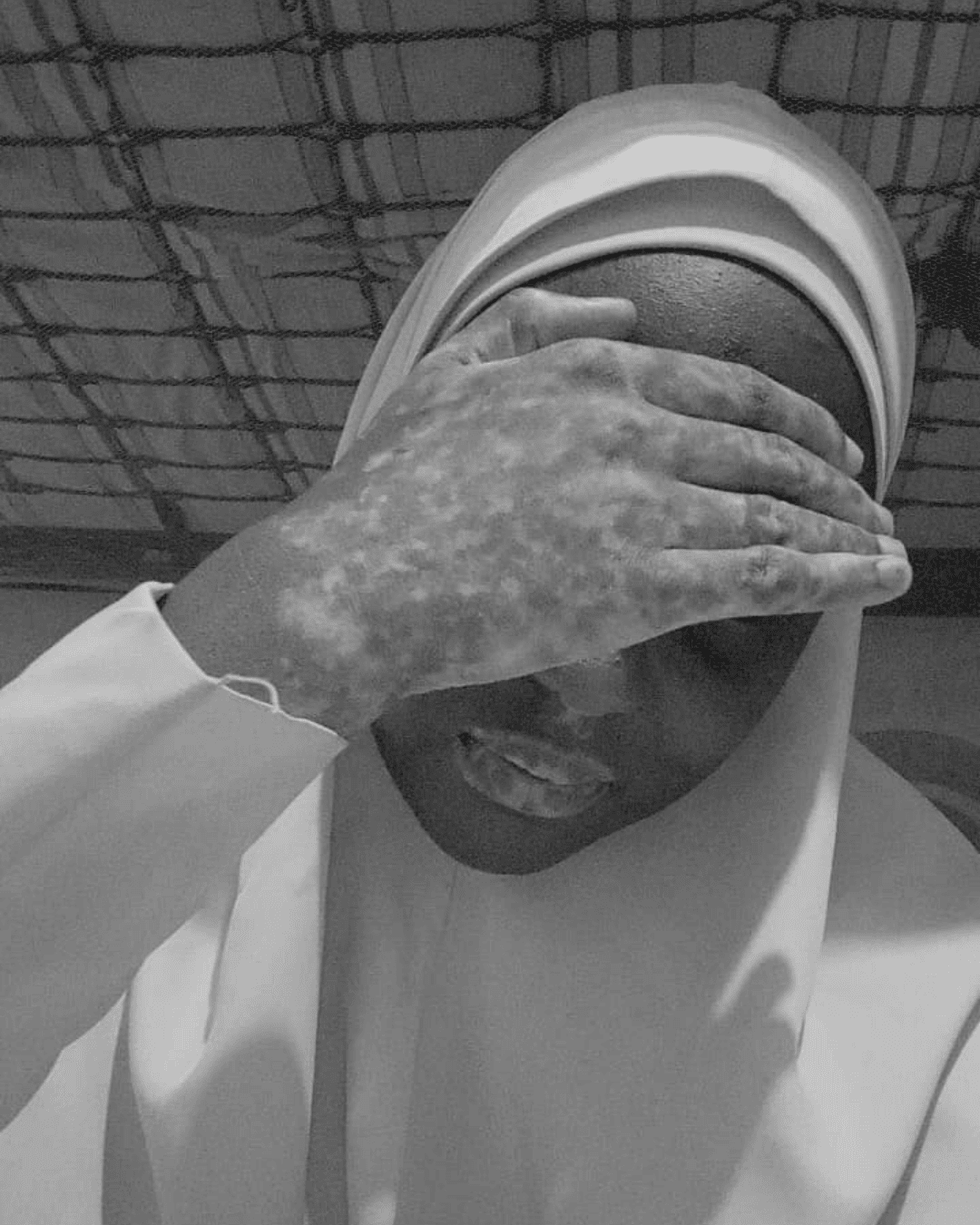
I was born in a nuclear family in Saminaka as the second child, but the first daughter, and my first couple of years were full of sunshine and rainbows. My mom didn’t give birth to another daughter till I was five and at that same age I experienced the biggest change of my life. At a funeral, an aunty noticed a pinkish colouration on my lips and pointed it out; my mom had noticed it earlier, but she didn’t know what it was. I was taken to a hospital in Zaria as soon as they found out. The hospital was called Saye and was famous for its dermatologists.
The first couple of times, my mom went with me, but soon after, I was entrusted to a driver named Aminu each time it was my appointment. It wasn’t negligence; my younger sister was just a couple of months old, and travelling every few weeks wasn’t ideal. But imagine a girl that young always being on the road by herself to seek a remedy that was not guaranteed. It wasn’t easy. As soon as I started medication, it spread to my hands and feet, and it spread fast. That alone gave my mother lots of sleepless nights. I was young, very young, but I was wiser than most my age. So, I knew I was the reason why she woke up most nights and cried. Thinking back now, those years of countless ups and downs, emotional turmoil, and taking medication that was meant for infection, like Funbact A, Nizerol, and so on, might truly have been a factor that sped up the spread. After a while, someone advised that we see a retired dermatologist from the same hospital, who was apparently knowledgeable. He prescribed meladinin for me, the tabs and the lotion, and instructed that I go out early in the morning to absorb the morning sun and wear socks afterwards, and it sort of worked. It stopped spreading, and I started repigmenting, slowly. Very slowly.
Shortly after, my younger sister, who was barely a year old, fell sick. So, my Mom focused on her and I missed my next appointment with the retired dermatologist. We didn’t go till a couple of months later, and, God, he was angry, outraged, and even scolded my mom for a decent amount of time. He said he was only going to check on me cause he liked me. He talked about how my condition needed persistence. We continued treating based on his instructions, but unfortunately he died shortly afterwards. Unfortunately, we had to go back to Saye, but there was no progress; in fact, it started spreading again even though they prescribed the same meladinin for me. Maybe we were using it wrong. Maybe it was the belief, but Saye simply wasn’t working.
Before I knew it, I started to experience the social implications. I can tell you, they were not good. Some looked at me with pity but kept silent, while others couldn’t, and their opinions were not solutions. Actually, thinking back now, it sounds taunting to me. Imagine a little girl as young as five, but all they talk about is how it would be challenging for me to find a husband. It terrified my mom so much that it became the first thing she usually asked God for while praying. I was so young when I realised that not getting married early or not having someone adore you was an abomination. Truly funny and outrageous.
Imagine a little girl as young as five, but all they talk about is how it would be challenging for me to find a husband.
When Saye didn’t work, some suggested we go for traditional treatment, and we did. My God! It was the beginning of another nightmare; I can’t count how many different medications I took – some bitter, some slimy, some continuously smelly. When my dad heard about a treatment where you dipped your foot in a fluid connected to different machines, we tried that also. When he heard a Chinese medical team was visiting, we sought their help. I took 20 injections during that time alone. When we heard a foreign medical team visited Ahmadu Bello Teaching Hospital and they were known to excel in dermatology, we tried that as well. My parents didn’t hesitate to invest time and money, even beyond what they could afford, as long as I got better. Somewhere in between all that medication, it stopped spreading. I was around 13-14 years old then. So, it was almost a decade of nonstop medication.
As for my interactions with people, it was both positive and negative. My teachers loved and treated me well because I was pretty smart, or maybe just lucky. I’m not sure. But I was doing really well with my studies. My classmates found every chance to tease and mock me. Sometimes, they even followed me after school closed, but I guess I built up a strong emotional defence, so it never got to me. The only thing that bothered me at the time was how much my situation disturbed my mom and how much medication I was taking. I travelled to different places, some alone, some with my parents. For some places, the roads were so bad that we could only ride a bike to get there. Some medications were so bad that they rotted with worms inside, and I still had to use them like that.
At some point, I got fed up. I was in my senior year then; nothing was changing, yet I was always taking endless stuff. So, I rebelled, not openly but secretly. I started throwing away the medicine. After a couple of months, our kitchen sink turned brown due to the amount of medicine I was pouring down there. My Mom found out; her reaction to it was one of the saddest things I’ve ever encountered. She cried a lot – a heart-wrenching one. She kept saying again and again, Aisha, what do I do with you? I couldn’t bear it. It broke me.
I hated vitiligo not because I found myself ugly, not because I was in pain, not even because of how much medicine I was taking, but because it disrupted my parents’ comfort. It made them sad, stressed out, frustrated, and I hated myself because I was the one who carried it.
After Mom’s outburst, I couldn’t give up anymore, not because I believed I’d get better, not even because I wanted to, but because it gave her a form of comfort. When I got admission into Ahmadu Bello University, Zaria, someone introduced me to a hospital in Kano called Bela. It was a long distance away from Kano city. Still, I went by myself. I kept undergoing treatment. Prednisolone was one of the drugs prescribed for me. After almost six months of going for countless appointments, I fell terribly sick and, later on, a visiting doctor from Aminu Kano Teaching Hospital (AKTH), Dr Shehu, if I remember correctly, realised the error of my taking it for a long time and transferred me to Ahmadu Bello University Teaching Hospital (ABUTH). At ABUTH, I was counselled by a doctor for a long time and, somehow, I got over everything. I wasn’t feeling emotionally drained or frustrated. Somehow, it didn’t seem like a big deal anymore, and I kept talking to my mom, convincing her to let it go, too. What is meant to happen will happen. She still worries, but she’s okay with it now.
That’s basically my journey with vitiligo. I’ve kept up the good habits I’ve learned, like eating fruits and veggies, and using sunscreen and covering up when I go out in the sun. But I’ve put a pause on medication, not because I gave up, but because now I only want to use medicine I’m comfortable with.
As narrated by: Aisha Musa (Saminaka, Kaduna).
This snippet is published as part of the series, The Complex Reality of Vitiligo.
Discover more from Chronycles
Subscribe to get the latest posts sent to your email.


Published by