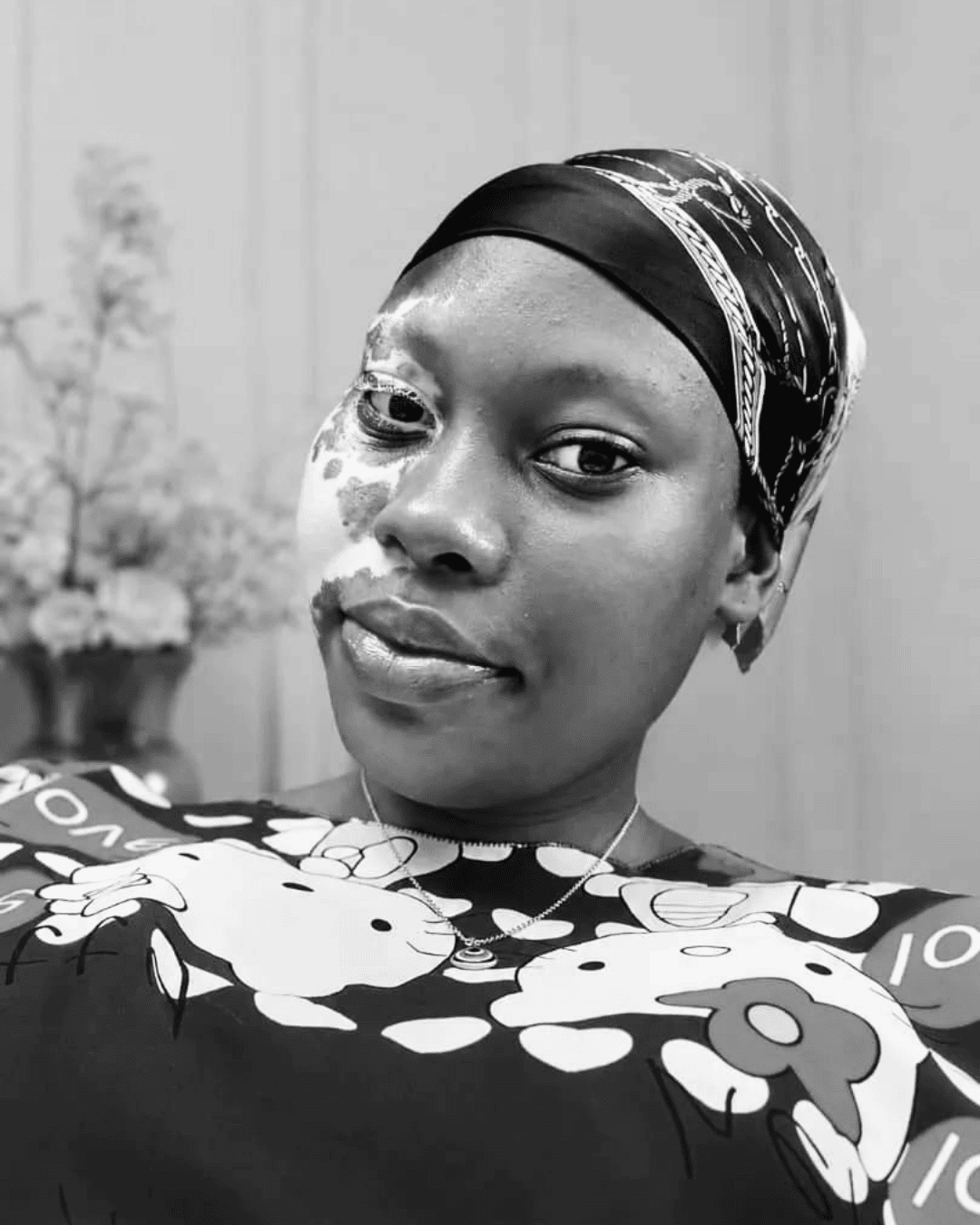
It began when I was about eight years old and in Primary 3. I remember noticing some changes in my skin that felt unfamiliar at the time, something I didn’t fully understand as a child. What started as small patches gradually became more noticeable, and it marked the beginning of a new reality I would grow into over the years.
In 2010, I was officially diagnosed with vitiligo. That moment not only gave a name to what I had been experiencing; it also came with a mix of emotions and questions, especially at such a young age. Growing up with it meant learning, adjusting, and gradually building confidence in my own skin. What once felt confusing became a part of my identity and story, one that continues to shape my perspective and strength today.
When it first began, I felt different in a way I couldn’t fully explain at that age. I looked around and didn’t see anyone who looked like me, and having a two-toned face made me very self-conscious. It affected how I saw myself. I became shy, withdrew at times, and gradually lost a part of my self-esteem. It was a confusing and lonely experience, trying to understand why I stood out in a way I hadn’t chosen.
However, my perspective began to change. I started to grow into my skin, not just physically but emotionally as well. Today, I feel confident and genuinely happy embracing my vitiligo. What once made me feel different in a negative way has become something I now see as beautiful and unique.
Shortly after I was officially diagnosed in 2010, I began a treatment regimen. At the time, I was prescribed Meladinine. I was also advised to expose my skin to sunlight, specifically around 10 a.m., for about 5 to 10 minutes daily.
As a child, I didn’t fully understand the science behind it, but I followed the routine as instructed. Looking back now, I realise it was part of a structured attempt to manage the condition and stimulate pigment. That period marked my first real introduction to living with vitiligo more intentionally, learning that it’s something that could be managed, even if the journey requires patience and consistency.
Vitiligo has shaped my relationships in different ways, but overall, it has been a journey of acceptance and support. From the beginning, my family and close friends made a conscious effort to understand what I was going through. Instead of making me feel different, they embraced me fully and showed me love beyond my appearance. Their support played a huge role in helping me rebuild my confidence, especially during the times I struggled with self-esteem.
As for the wider community, my experience has also been largely positive. People have related well with me and treated me with respect, even with my visible differences. While there may have been moments of curiosity, I’ve found that most interactions have been grounded in acceptance. This has helped me feel more comfortable in my own skin and more open in expressing myself without fear.
There was a time when vitiligo deeply affected my social life, especially when my self-esteem was low. I became more withdrawn and hesitant to interact with people. Social gatherings felt uncomfortable, so I often avoided them altogether. Instead of expressing myself freely, I kept to myself.
As I grew older and began to accept myself more, that started to change. I gradually became more open, more willing to connect, and less concerned about how others perceived me. My social life is no longer defined by fear or avoidance. Instead, it reflects confidence and a willingness to show up as I am.
When it comes to romantic relationships, my experience has been quite positive. Vitiligo has not been a barrier for me in that area. I’ve been in situations where I was accepted and appreciated for who I am, beyond my physical appearance.
Being loved and chosen without conditions helped reinforce my self-worth and reminded me that genuine connection goes deeper than skin. It showed me that the right people see me for me, and that has made my approach to relationships more confident and grounded.
My experience with discrimination has changed over the years. When it first started, it came in the form of hurtful words and name-calling. I was called names like “albino,” accused of bleaching my skin, and even given labels like “Coke and Fanta.” Those comments were painful, especially at a young age, and they affected how I saw myself.
As I’ve grown older, the reactions have shifted. It’s less about direct insults now and more about subtle behaviours, like people staring for too long or expressing pity, sometimes saying “sorry” as if something is wrong with me. While it may not always be spoken outright, those moments can still feel uncomfortable. However, I’ve learned not to internalise those reactions. Instead, I focus on how I see myself and continue to embrace my identity with confidence.
It’s less about direct insults now and more about subtle behaviours, like people staring for too long or expressing pity, sometimes saying “sorry” as if something is wrong with me.
I’ve found myself in some surprisingly funny and unforgettable situations because of my vitiligo. One that always stands out is how babies, especially between 6 and 9 months, sometimes react when they see me. The moment they notice my face, some of them just refuse to come close or be carried, and their expressions can be so dramatic that it becomes hard not to laugh.
With slightly older children, around 2 to 10 years, their imagination takes it even further. A few of them have genuinely thought I was a masquerade or something like “ojuju calabar”. The way they say it with so much seriousness and curiosity can be shocking at first, but later it turned into something I laugh about.
Another funny scenario is when people try to “figure me out” by asking the most unexpected or awkward questions, sometimes whispering or staring as if they’re solving a mystery. Moments like these, while awkward, have also added a lighter side to my journey. They remind me that not every reaction has to be taken to heart sometimes; it’s okay to just laugh and move on.
I’m highly sensitive to the sun. I’ve come to realise that my skin doesn’t tolerate prolonged sun exposure very well. Whenever I go out without proper protection like an umbrella or a scarf, I tend to feel the effects quickly. It often starts with a headache, and sometimes my vision even becomes blurry, which can be very uncomfortable and limiting.
Because of this, I’ve learned to be more intentional about how I handle sun exposure. I make sure to protect myself whenever I’m stepping out, whether by using an umbrella, covering up, or avoiding staying too long under direct sunlight. Over time, it has become part of my routine to be mindful of my environment and take the necessary steps to stay comfortable and safe while going about my day.
Aside from that, I have not experienced any other vitiligo-linked health conditions. However, I’ve learned to pay close attention to how my body reacts to environmental factors, especially the sun, and I take precautions early to avoid any discomfort.
To anyone living with vitiligo, my message is simple: you are not less, and you are not alone. Vitiligo does not reduce your value or define your worth; it only changes your appearance, not your identity or your potential.
There may be days when it feels difficult, especially when dealing with stares, questions, or self-doubt, but those moments do not last forever. With time, acceptance grows, and your confidence becomes stronger. Your uniqueness is not something to hide; it is something that sets you apart beautifully.
Embrace yourself fully, protect your peace, and surround yourself with people who see beyond your skin. Most importantly, learn to see yourself the way you truly are: whole, capable, and worthy of love and respect.
And to those who feel different in any way, don’t let the world’s perception change how you see yourself. You are enough, just as you are.
To everyone out there, I want to say this: be kind, be open-minded, and learn to see beyond what is on the surface. People are not defined by their appearance, skin condition, or physical differences, but by who they are inside.
Before you judge, stare, or speak, try to understand that everyone is fighting their own battles, some visible, many invisible. A little kindness can go a long way in making someone feel accepted and valued.
As narrated by: Ruth Omolara Akinwole (Ede, Osun).
Studying Networking and Cloud Computing Technology at the Federal Polytechnic, Ede. Deeply curious about how systems connect, communicate, and function behind the scenes.
This snippet is published as part of the series, The Complex Reality of Vitiligo.
Discover more from Chronycles
Subscribe to get the latest posts sent to your email.


Published by