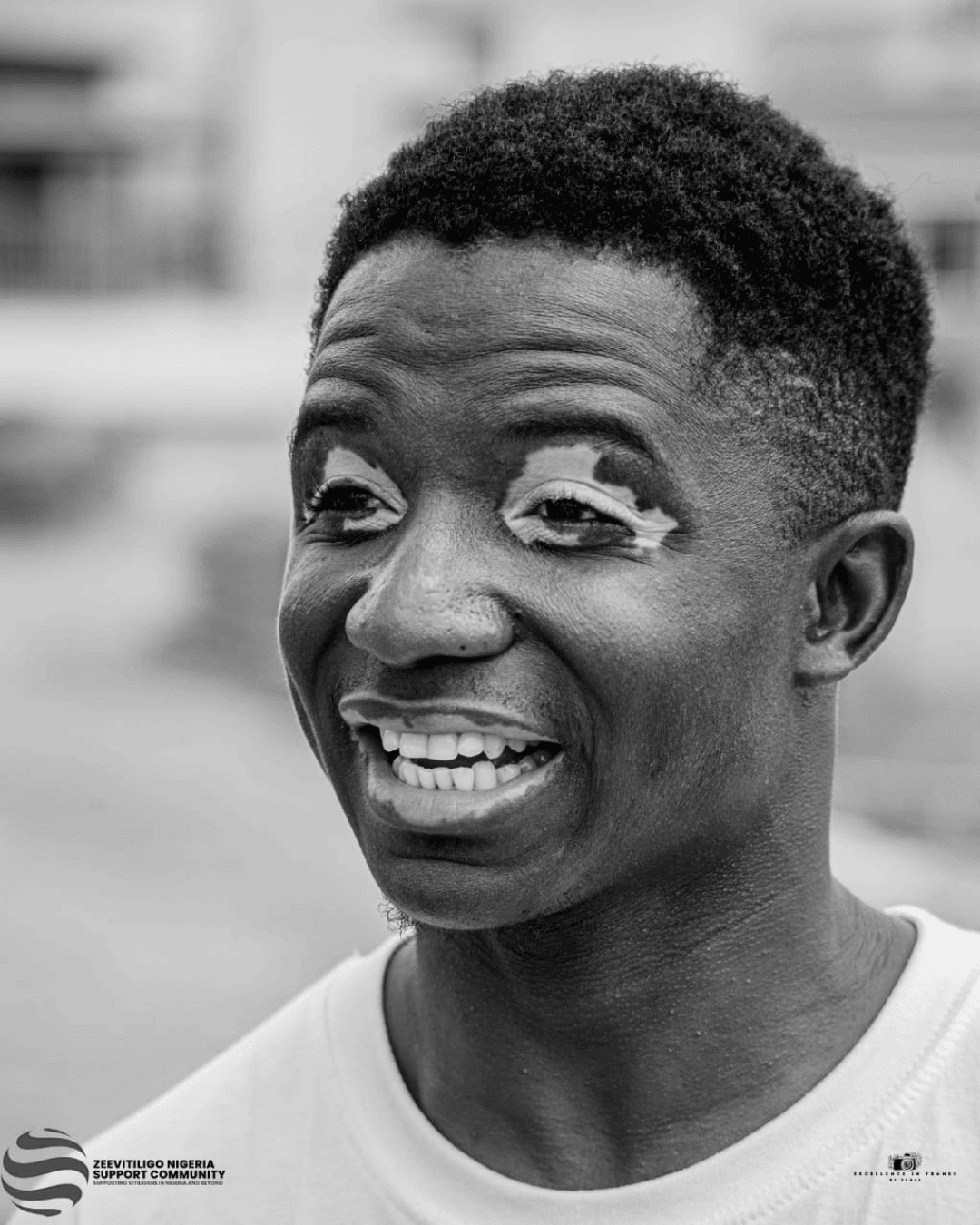
I first noticed changes in my skin when I was between five and eight years old. It started as a small white spot on my left eyelid. At first, it was barely noticeable, and I did not think much of it. As time went on, however, the spot gradually became larger and more visible.
When my mother noticed it, she thought it was a scratch and advised me to stop rubbing my eye. Unfortunately, the patch continued to grow and spread. As it became more noticeable, my family became more concerned.
In search of a solution, my mother took me to several local herbalists and explored different remedies that people recommended. Nothing seemed to work. Instead, the vitiligo continued to spread, eventually affecting the area around my other eye.
At one point, a team of doctors from the United States visited a hospital in my neighbourhood. My mother took me there for a medical evaluation, hoping to find answers. After I was examined, the doctors explained that vitiligo is a skin condition that causes loss of skin pigment in certain areas. They reassured us that it was not contagious and that it was not caused by anything I had done.
As I grew older, living with vitiligo came with its own challenges. There were moments when I felt different from others and struggled with questions and comments about my appearance. But over time, I began to understand that my condition does not define my worth.
Today, I see my vitiligo as part of my story rather than a limitation. It has taught me resilience and self-acceptance. While the journey has not always been easy, it has helped shape me into the person I am today.
Looking back at how I learned to cope with vitiligo, it all began during my primary school days. Back then, the patches weren’t very widespread, but people noticed them. The elderly often assumed it was a burn injury. As for my peers, many began to distance themselves, though I was fortunate to have a few understanding friends who stuck by me. Despite the emotional trauma, I refused to let it affect my education. In 2011, I graduated from primary school near the top of my class.
That same year, I transitioned into secondary school. At the time, my family was facing severe financial difficulties, so instead of taking me to a modern medical centre, they could only afford cheaper treatments from local herbal doctors.
My early days in secondary school were among the toughest moments of my life. The stigma was overwhelming; I faced constant bullying, name-calling, and discouragement. People made up cruel explanations for my condition. Some claimed I was burned as a punishment for being stubborn, or that I had fallen into a pot of hot food out of greed. Others joked that I was meant to be a white person, but a tragedy happened, or that I was a native doctor born into a modern world. I was taunted with nicknames like Boka (native doctor), “eye shadow,” and “the eyes of the gods.”
People made up cruel explanations for my condition. Some claimed I was burned as a punishment for being stubborn, or that I had fallen into a pot of hot food out of greed.
Initially, I tried to fight back and report the bullies to the school authorities. But even though they were punished, it felt like adding petrol to a fire—the teasing only intensified. Eventually, a staff member pulled me aside and advised me to ignore the noise, accept the situation, and focus entirely on my studies. I took that advice, embraced those names as mere nicknames, and finally found peace.
Another major challenge was dealing with strangers’ curiosity when I was a child. People constantly asked questions I didn’t know how to answer, like “How did that happen?” or “What caused it?” Back then, I didn’t even know the word vitiligo myself. Sometimes, little kids would see me and run away crying as if they had seen a monster. I vividly remember walking past a house where a girl my age was sitting on the veranda. She ran inside screaming, “Mom, come out and see a native doctor!” That broke my heart, but I kept moving forward.
When it came to relationships, I didn’t experience too many issues early on because I grew up an introvert. I kept a very small circle of friends and spent most of my time indoors. However, pursuing romantic relationships later on was terrifying. The fear of rejection paralysed me; I worried it would break me into pieces, so I ignored anyone who approached me. It was only after I educated myself deeply about vitiligo that I truly accepted it, broke down those emotional boundaries, and moved forward.
While studying at ABU Zaria, I met Blessing Ojoma, the co-founder of the Zee-Vitiligo Foundation. Meeting her became a major turning point in my journey. Through the foundation, I learned so much more about vitiligo and how to truly thrive. Today, I am incredibly happy and proud to be part of this foundation, helping to raise awareness, educate the public, and bring encouragement to fellow vitiligo warriors.
As narrated by: Yakubu Gabriel (Ogun, Nigeria).
This snippet is published as part of the series, The Complex Reality of Vitiligo.
Discover more from Chronycles
Subscribe to get the latest posts sent to your email.

Published by