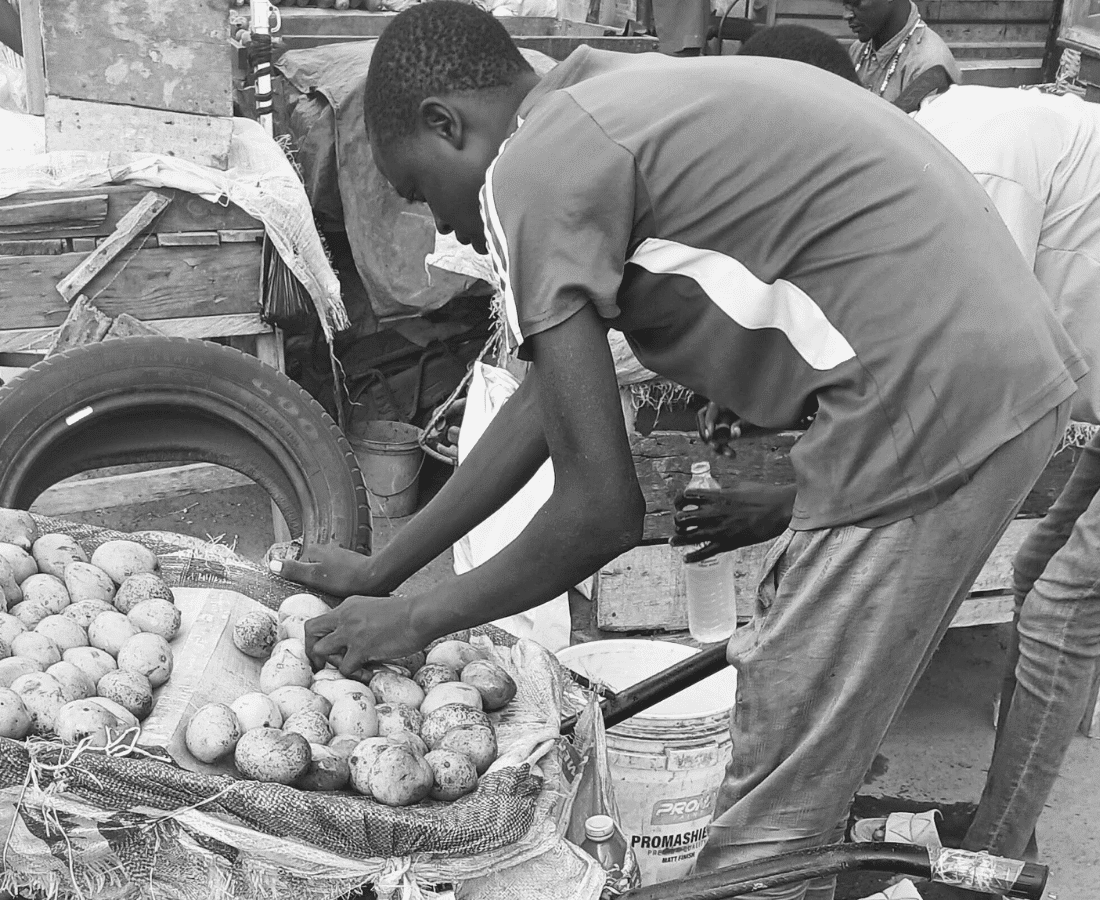
I am a street fruit vendor who operates not just in Ifako. I also push my ‘two-wheel vehicle’ (wheelbarrow) around other places sometimes. I sell fresh fruits, typically mangoes and seasonal produce.
My business is small but tough. I don’t sell on credit. If my fruits spoil, I lose money. Every day is like a fresh investment. I go to the market early, buy what I can afford, transport it myself or with help, and start selling. Whatever is left in the evening is either sold at a reduced price or becomes a loss, except it is something scarce and customers need it; that is when it can go for a higher price.
I do not have permanent staff, but sometimes a young boy helps me carry goods or watch the stand when I step away. I pay him for the particular time of work he does because I can’t afford to make regular payments. In this kind of small business, profit is not certain.
I have family outside Lagos that I cater for, particularly my siblings. People buy fruits every day. Even though the environment is tough, the opportunity is still there.
You are selling, attending to customers, arranging your goods, and suddenly someone appears asking for money, not once or twice. Sometimes repeatedly. Standing in front of your goods and delaying you for 20 minutes could make you lose customers. If they cause a scene, people, especially customers, would avoid your stand because nobody wants to go home with an injury for what doesn’t concern them. Everybody minds their business in Lagos.
I pay ₦200 for tickets here. At least in a month, that’s ₦6,000. And that doesn’t protect you. This is not just about the continuous ticket fees. It is very much more than that. The time lost during their interruptions, the stress of uncertainty, the inability to plan your finances is a whole lot itself. If I lose money during the day due to these interruptions, I may increase prices slightly the next day. However, I can’t increase too much because customers compare prices. Hence, in this business, I have learnt I don’t need to argue too much. I pay what I can quickly just to keep selling.

Nobody tells you, “This is all you will have to pay today”. This is aside from the money without ticket or anything given to show for the levies paid.
Because at the end of the day, your goal is not to win an argument. It is to complete your sales.
Each time I transport and buy goods, I have to pay those who load and carry them, and settle ‘agbero boys’ before I can eventually gain exit access. Every transporter or even motorist prays that their buses or cars don’t get damaged on the road. It’s not just about getting robbed or attacked, but also the need to sort out ‘area boys’. That alone is draining, despite the fact that it rarely happens.
For a business whose sales cannot really be determined and even calculated before complete sales because it is perishable, it is sometimes exhausting, not to mention the levies paid across all these channels just to survive.
As narrated by: Ibrahim Ahmed (Ifako, Lagos).
This snippet is published as part of the series, The Art of Taxing Poverty.
Discover more from Chronycles
Subscribe to get the latest posts sent to your email.

Published by